
The Nature Aquarium Hardscape & Aquascape Design Guide
The Nature Aquarium Hardscape & Aquascape Design Guide
Creating a successful nature aquarium involves more than simply arranging plants and decorations inside an aquarium. Strong aquascaping combines artistic composition, hardscape structure, plant selection, lighting, nutrient management, and long-term maintenance into a cohesive underwater ecosystem.
Hardscape serves as the structural foundation of the aquascape, shaping the visual flow, depth, balance, and atmosphere of the aquarium. Whether creating dramatic cliff formations, minimalist stone layouts, forest-inspired scenes, or densely planted Dutch aquariums, thoughtful hardscape design is one of the most important aspects of successful aquascaping.
This guide explores popular aquascape layout styles, hardscape design principles, commonly used materials, and practical strategies used to create naturalistic planted aquariums inspired by rivers, forests, mountains, and landscapes found in nature.
Understanding the Role of Hardscape in a Nature Aquarium
Hardscape refers to the non-living structural elements within an aquascape, including rocks, driftwood, substrate, and decorative materials. A well-designed hardscape establishes the visual framework of the aquarium and influences how plants, fish, and open space interact throughout the layout.
Strong hardscape design helps:
- Establish focal points
- Create depth and perspective
- Guide visual flow throughout the aquarium
- Support plant placement and composition
- Provide shelter and territory for aquatic fauna
- Enhance long-term visual balance as plants mature
The most successful nature aquariums typically balance structure and simplicity, allowing both hardscape and plant growth to complement one another naturally.
Popular Nature Aquarium Layout Styles
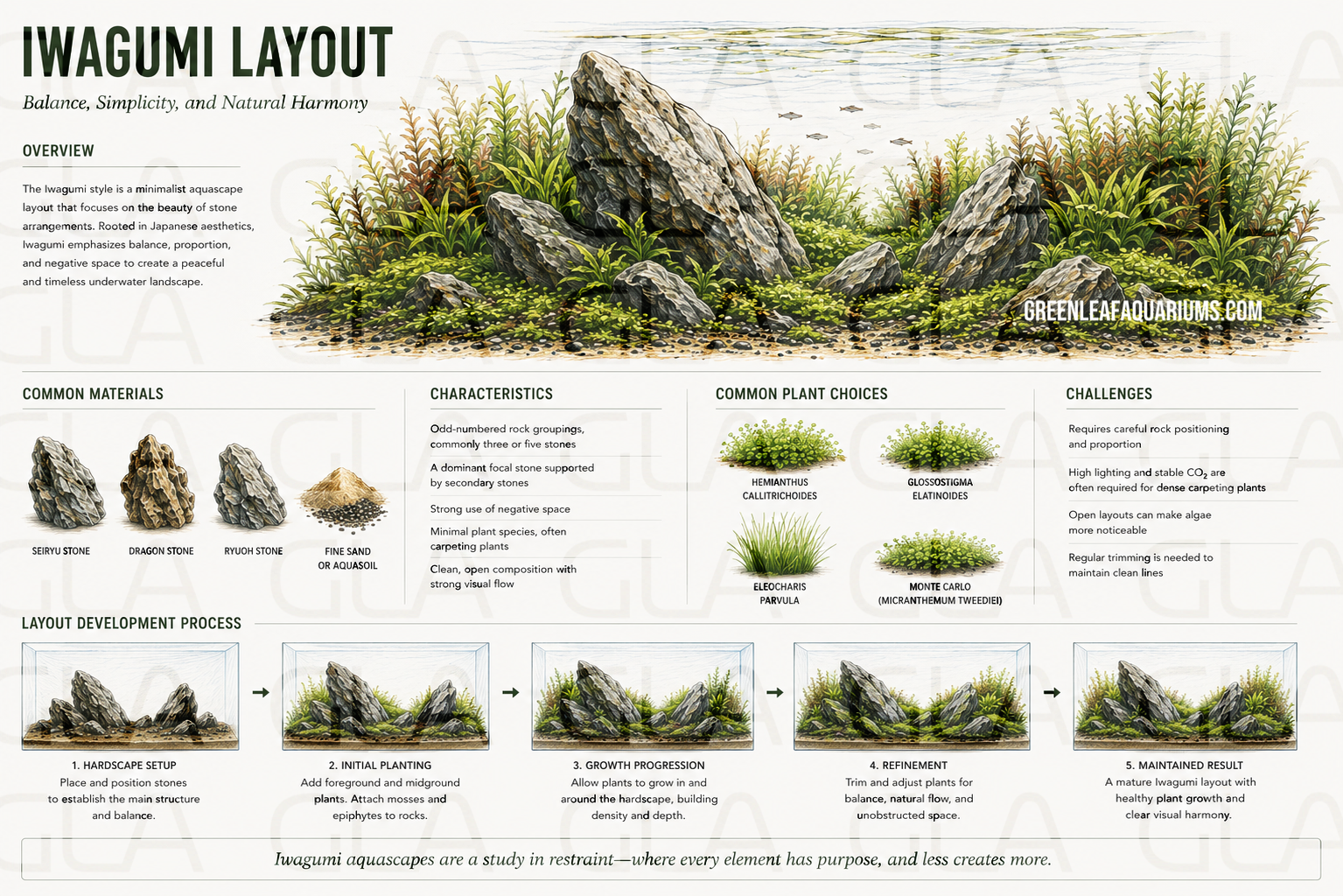
1. Iwagumi Layout
Overview
The Iwagumi style is a minimalist aquascape layout centered around stone composition and balance. Inspired by traditional Japanese rock arrangement principles, Iwagumi layouts often use a limited plant palette while emphasizing open space, proportion, and visual harmony.
Common Materials
- Seiryu Stone
- Dragon Stone
- Ryuoh Stone
- Fine sand or aquasoil
Characteristics
- Odd-numbered rock groupings, commonly three or five stones
- A dominant focal stone supported by secondary stones
- Strong use of negative space
- Minimal plant species, often carpeting plants
- Clean, open composition with strong visual flow
Common Plant Choices
- Hemianthus callitrichoides
- Glossostigma elatinoides
- Eleocharis parvula
- Monte Carlo (Micranthemum tweediei)
Challenges
- Requires careful rock positioning and proportion
- High lighting and stable CO2 are often required for dense carpeting plants
- Open layouts can make algae more noticeable
- Regular trimming is needed to maintain clean lines
Iwagumi layouts are often deceptively difficult because fewer elements leave little room to hide compositional mistakes.
2. Ryoboku Layout (Nature Wood Layout)
Overview
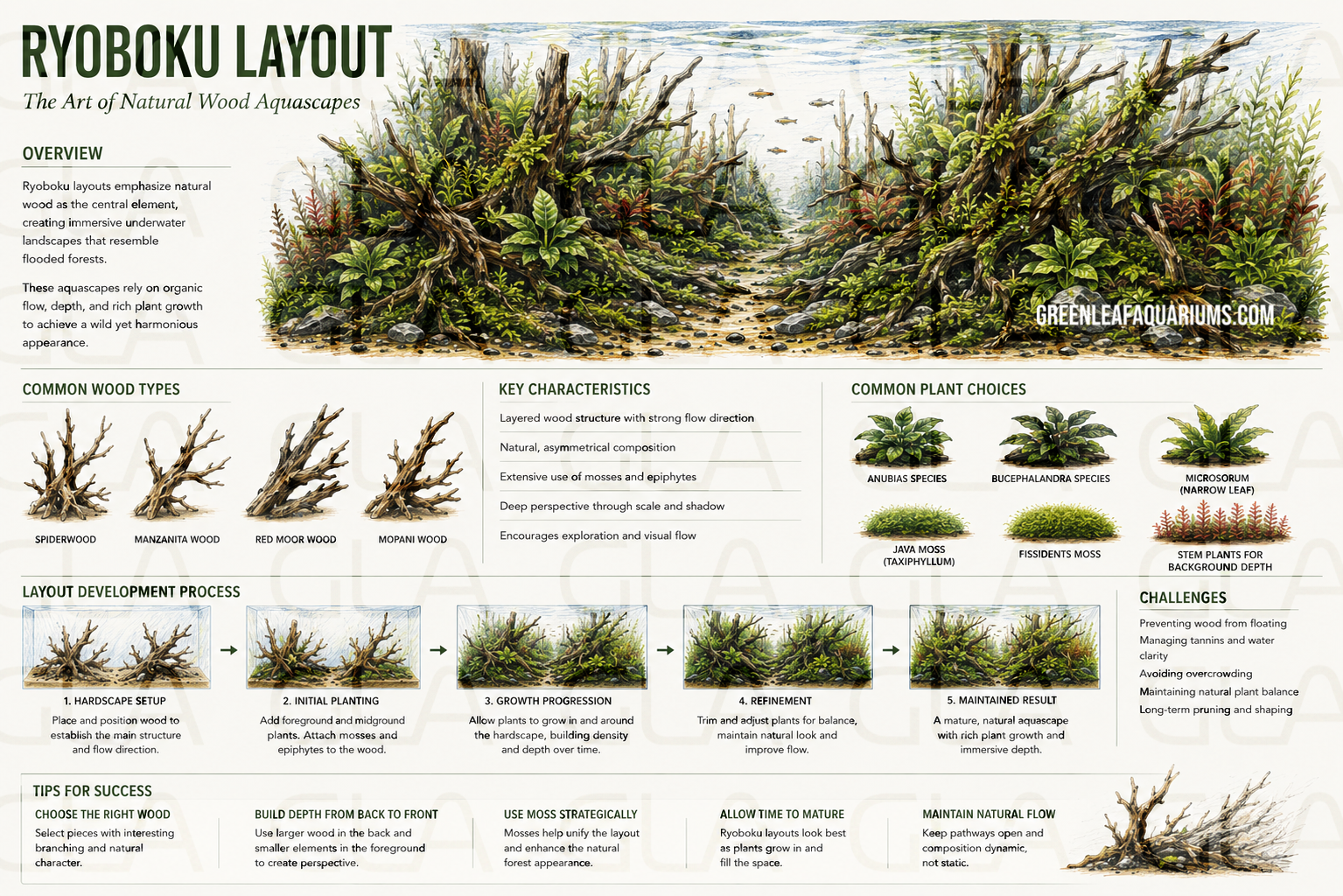
Ryoboku layouts focus primarily on driftwood composition to recreate submerged roots, fallen trees, and forest-like underwater environments. These layouts often appear more organic and dynamic than minimalist stone-focused aquascapes.
Common Materials
- Spiderwood
- Manzanita wood
- Red Moor wood
- Supporting stone structures
Characteristics
- Layered driftwood arrangements with directional flow
- Natural, asymmetrical composition
- Use of shadowing and depth for realism
- Heavy integration of epiphytes and mosses
- Strong visual movement created through branch orientation
Common Plant Choices
- Anubias species
- Bucephalandra species
- Java Fern
- Mosses such as Christmas Moss or Weeping Moss
- Stem plants for background contrast
Challenges
- Avoiding visual clutter
- Maintaining open swimming space
- Balancing dense hardscape with healthy plant growth
- Preventing excessive shading in lower areas
Ryoboku aquascapes often create some of the most natural and immersive planted aquarium environments.
3. Dutch Layout
Overview
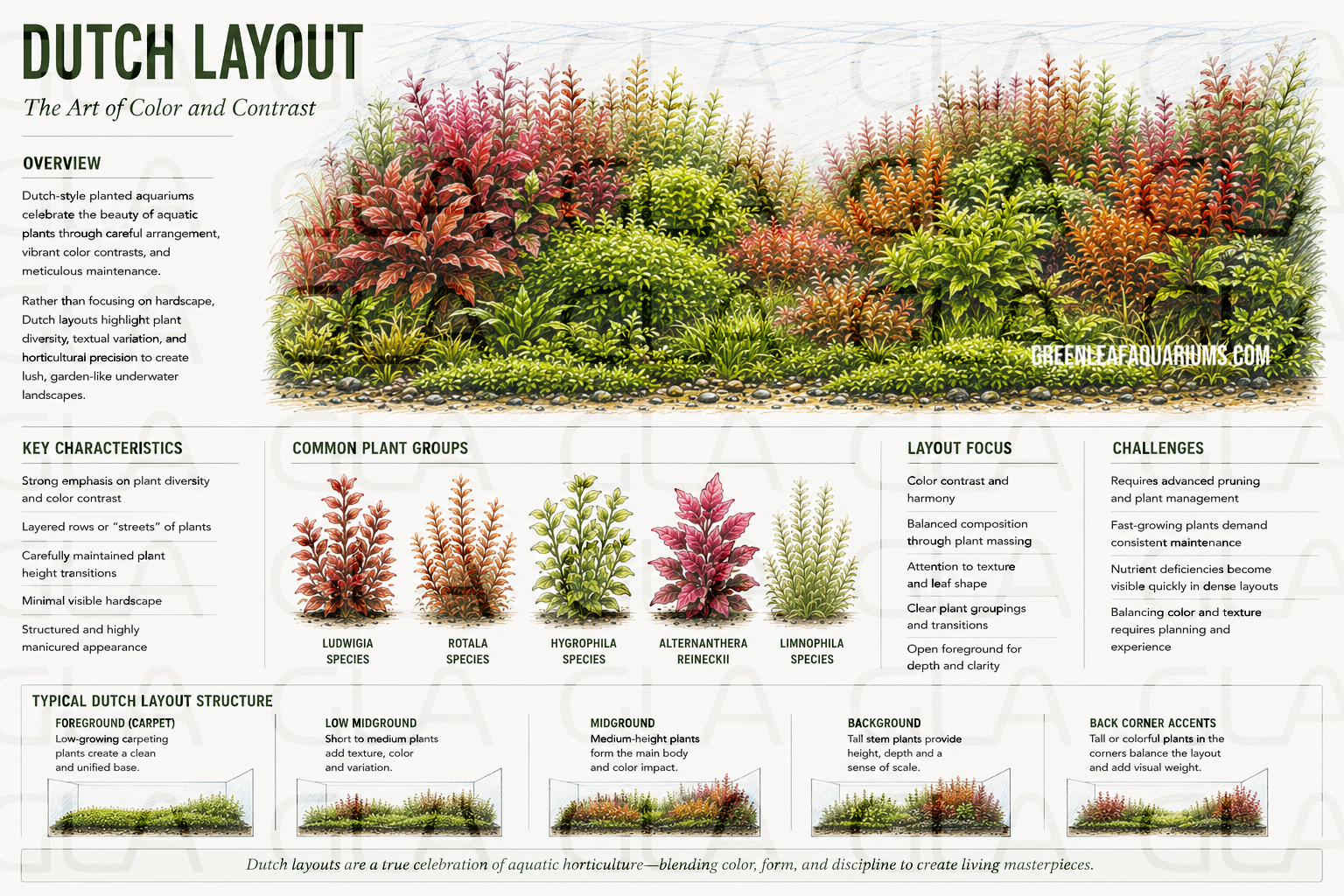
Dutch-style planted aquariums focus heavily on plant arrangement, color contrast, texture variation, and structured pruning techniques rather than dramatic hardscape composition.
Characteristics
- Strong emphasis on plant diversity and color contrast
- Layered rows or “streets” of plants
- Carefully maintained plant height transitions
- Minimal visible hardscape
- Structured and highly manicured appearance
Common Plant Choices
- Ludwigia species
- Rotala species
- Hygrophila species
- Alternanthera reineckii
- Limnophila species
Challenges
- Requires advanced pruning and plant management
- Fast-growing plants demand consistent maintenance
- Nutrient deficiencies become visible quickly in dense layouts
- Balancing color and texture requires planning and experience
Dutch aquariums showcase the artistic side of aquatic plant cultivation and reward aquarists who enjoy detailed plant maintenance.
4. Forest Layout
Overview
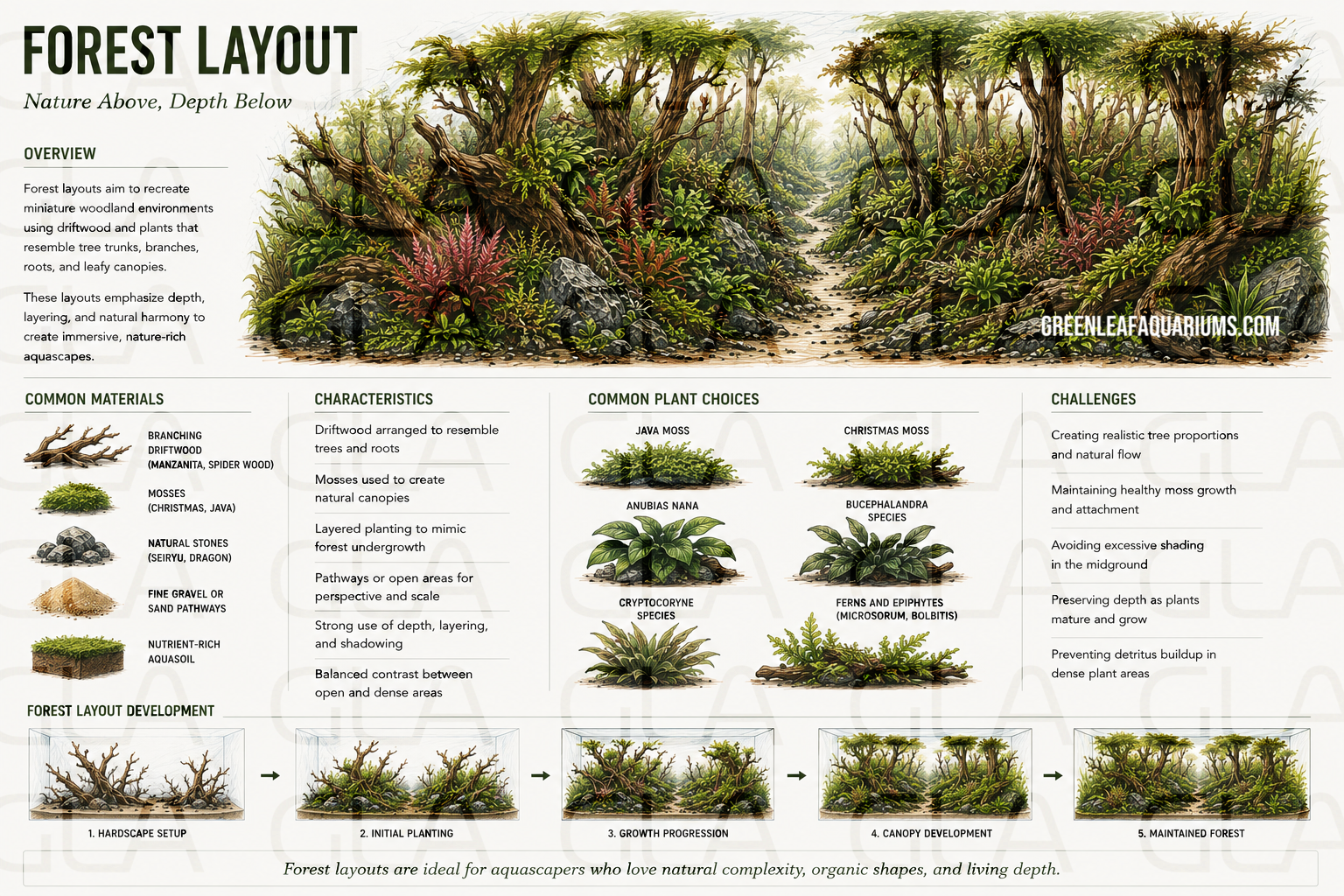
Forest layouts aim to recreate miniature underwater forests using driftwood structures that resemble tree trunks, roots, and canopies.
Common Materials
- Branching driftwood
- Mosses
- Small stones
- Fine gravel or sand pathways
Characteristics
- Driftwood arranged to resemble trees and roots
- Mosses used to create canopy effects
- Layered planting to mimic forest undergrowth
- Pathways or open clearings for perspective
- Strong use of depth and shadowing
Common Plant Choices
- Christmas Moss
- Java Moss
- Anubias nana
- Cryptocoryne species
- Ferns and epiphytes
Challenges
- Creating realistic tree proportions
- Maintaining healthy moss growth
- Avoiding excessive shading
- Preserving depth as plants mature
Forest layouts are particularly effective for creating immersive and cinematic aquascapes.
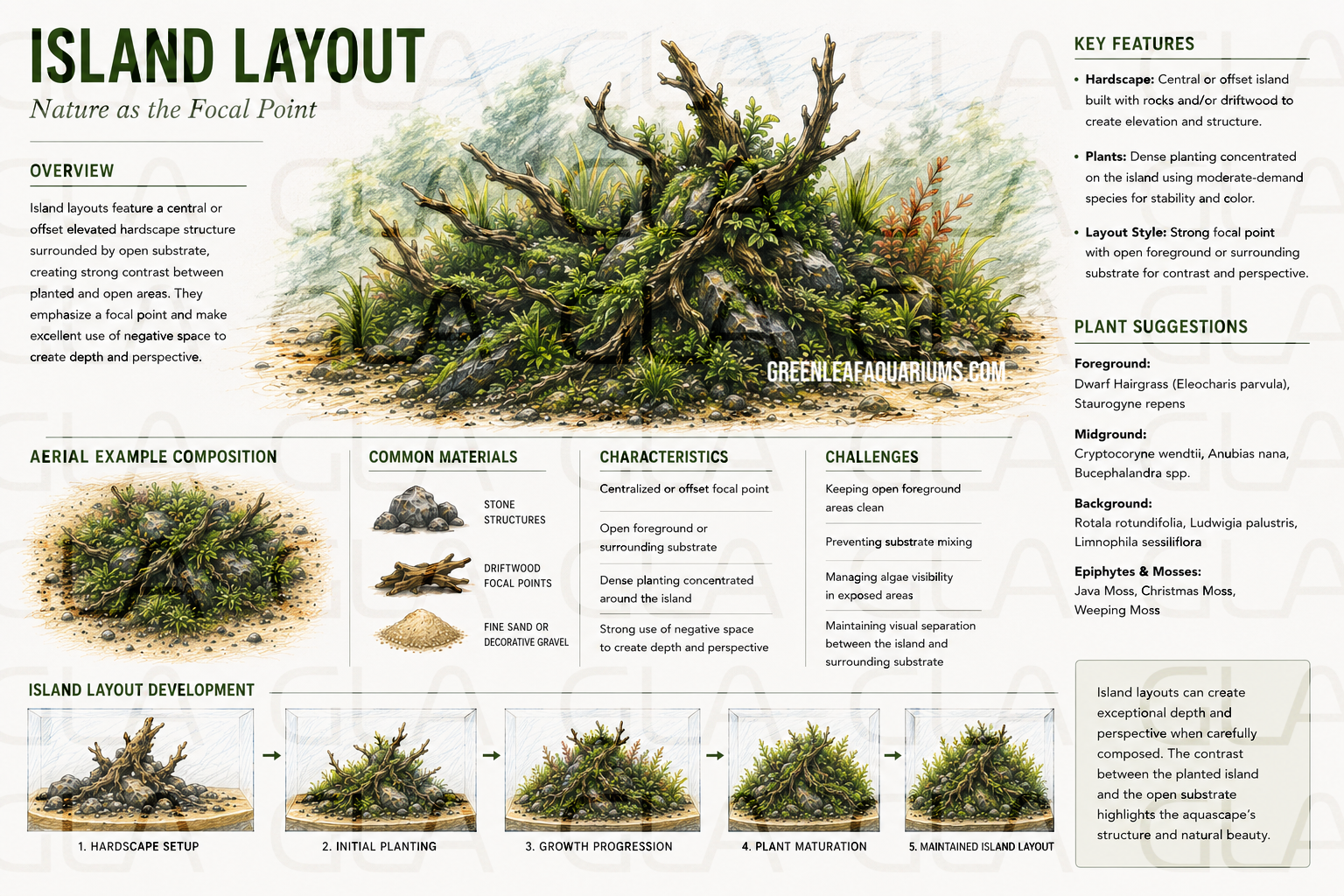
5. Island Layout
Overview
Island layouts feature a central or offset elevated hardscape structure surrounded by open substrate, creating strong contrast between planted and open areas.
Common Materials
- Stone structures
- Driftwood focal points
- Fine sand or decorative gravel
Characteristics
- Centralized or offset focal point
- Open foreground or surrounding substrate
- Dense planting concentrated around the island
- Strong use of negative space
Challenges
- Keeping open foreground areas clean
- Preventing substrate mixing
- Managing algae visibility in exposed areas
- Maintaining visual separation between the island and surrounding substrate
Island layouts can create exceptional depth and perspective when carefully composed.
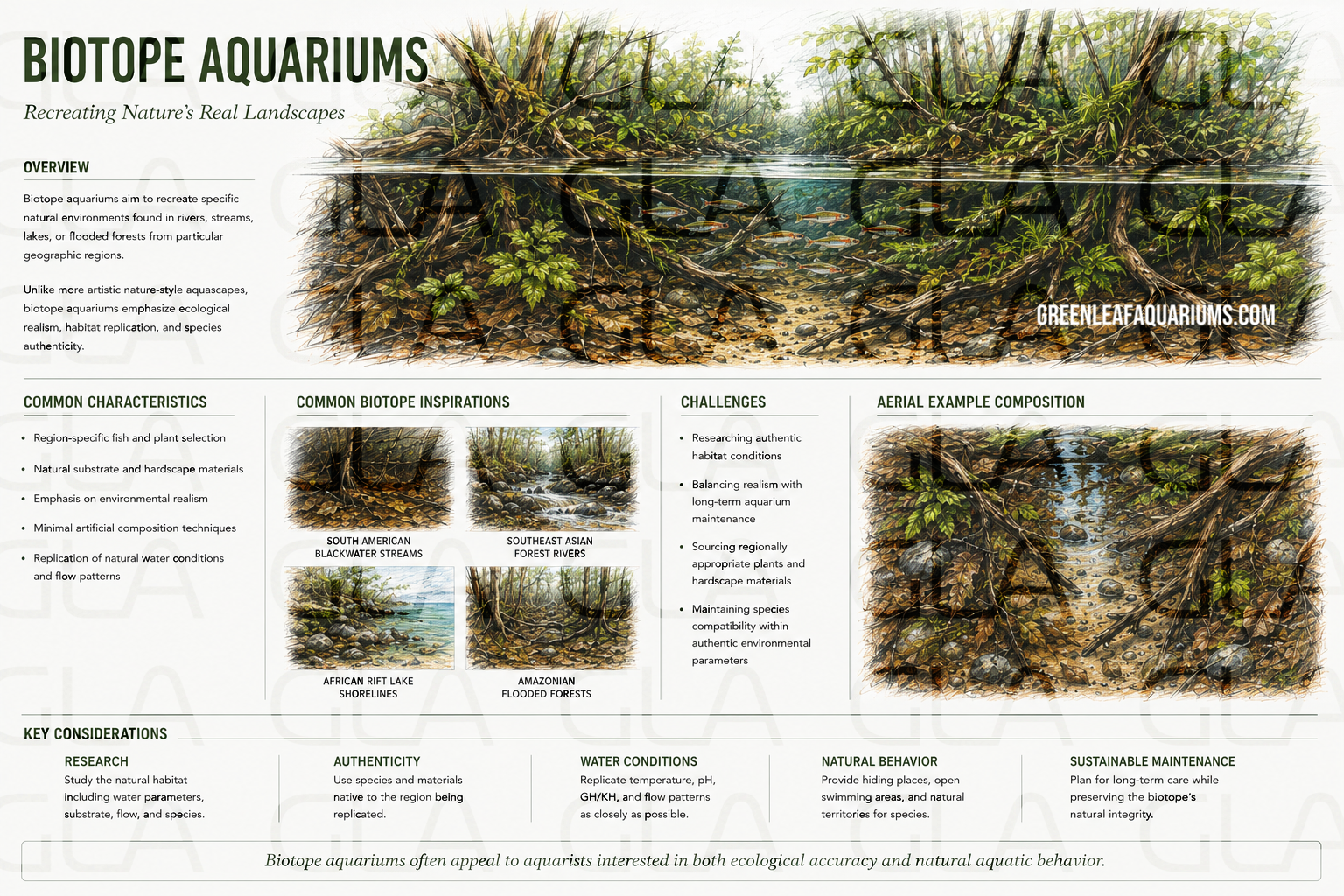
6. Biotope Aquariums
Overview
Biotope aquariums focus on recreating specific natural environments found in rivers, streams, lakes, or flooded forest systems from particular geographic regions.
Unlike more artistic nature-style aquascapes, biotope aquariums emphasize ecological realism, habitat replication, and species authenticity.
Common Characteristics
- Region-specific fish and plant selection
- Natural substrate and hardscape materials
- Emphasis on environmental realism
- Minimal artificial composition techniques
- Replication of natural water conditions and flow patterns
Common Biotope Inspirations
- South American blackwater streams
- Southeast Asian forest rivers
- African Rift Lake shorelines
- Amazonian flooded forests
Challenges
- Researching authentic habitat conditions
- Balancing realism with long-term aquarium maintenance
- Sourcing regionally appropriate plants and hardscape materials
- Maintaining species compatibility within authentic environmental parameters
Biotope aquariums often appeal to aquarists interested in both ecological accuracy and natural aquatic behavior.
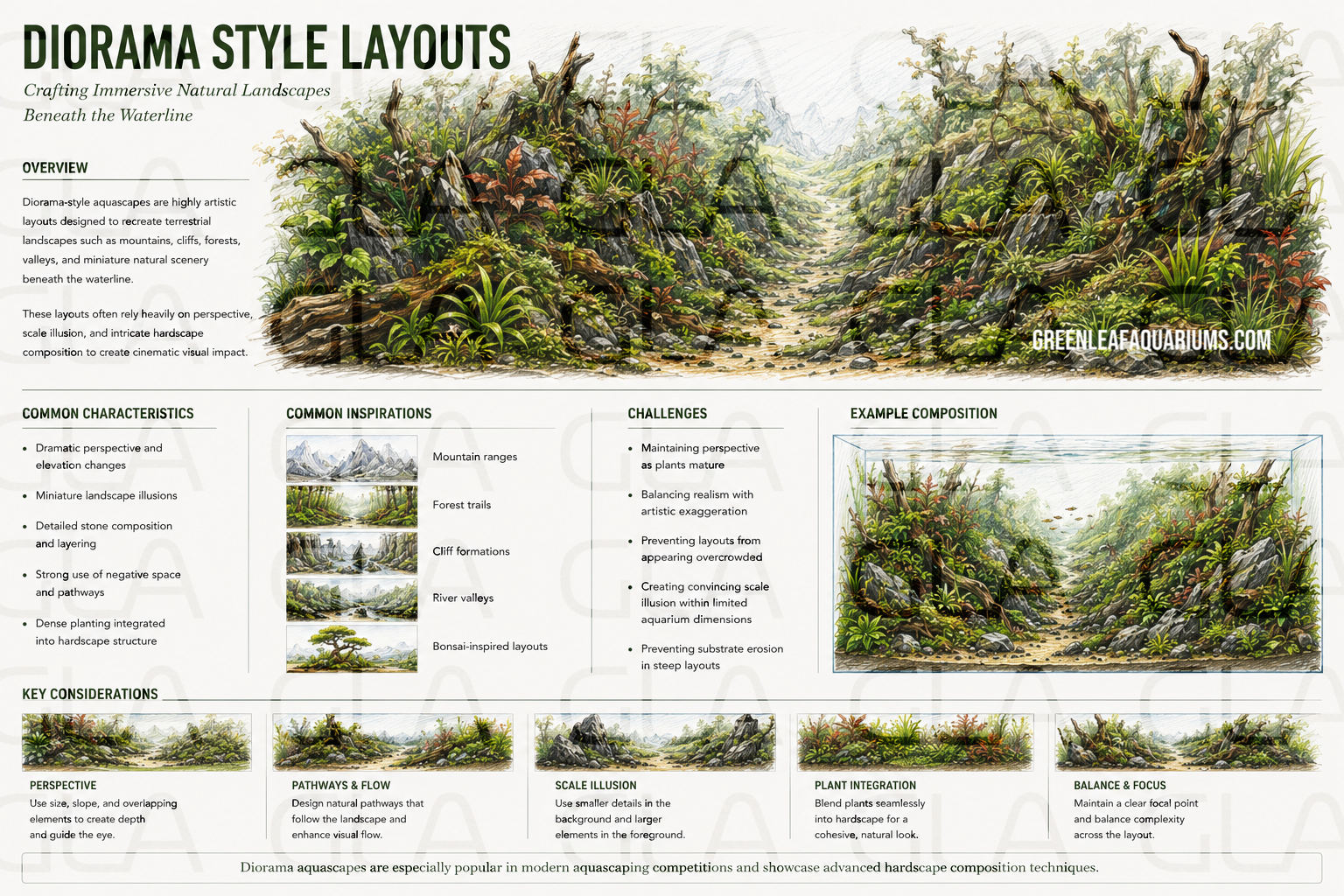
7. Diorama Style Layouts
Overview
Diorama-style aquascapes are highly artistic layouts designed to recreate terrestrial landscapes such as mountains, cliffs, forests, valleys, and miniature natural scenery beneath the waterline.
These layouts often rely heavily on perspective, scale illusion, and intricate hardscape composition to create cinematic visual impact.
Common Characteristics
- Dramatic perspective and elevation changes
- Miniature landscape illusions
- Detailed stone composition and layering
- Strong use of negative space and pathways
- Dense planting integrated into hardscape structure
Common Inspirations
- Mountain ranges
- Forest trails
- Cliff formations
- River valleys
- Bonsai-inspired layouts
Challenges
- Maintaining perspective as plants mature
- Balancing realism with artistic exaggeration
- Preventing layouts from appearing overcrowded
- Creating convincing scale illusion within limited aquarium dimensions
Diorama aquascapes are especially popular in modern aquascaping competitions and showcase advanced hardscape composition techniques.
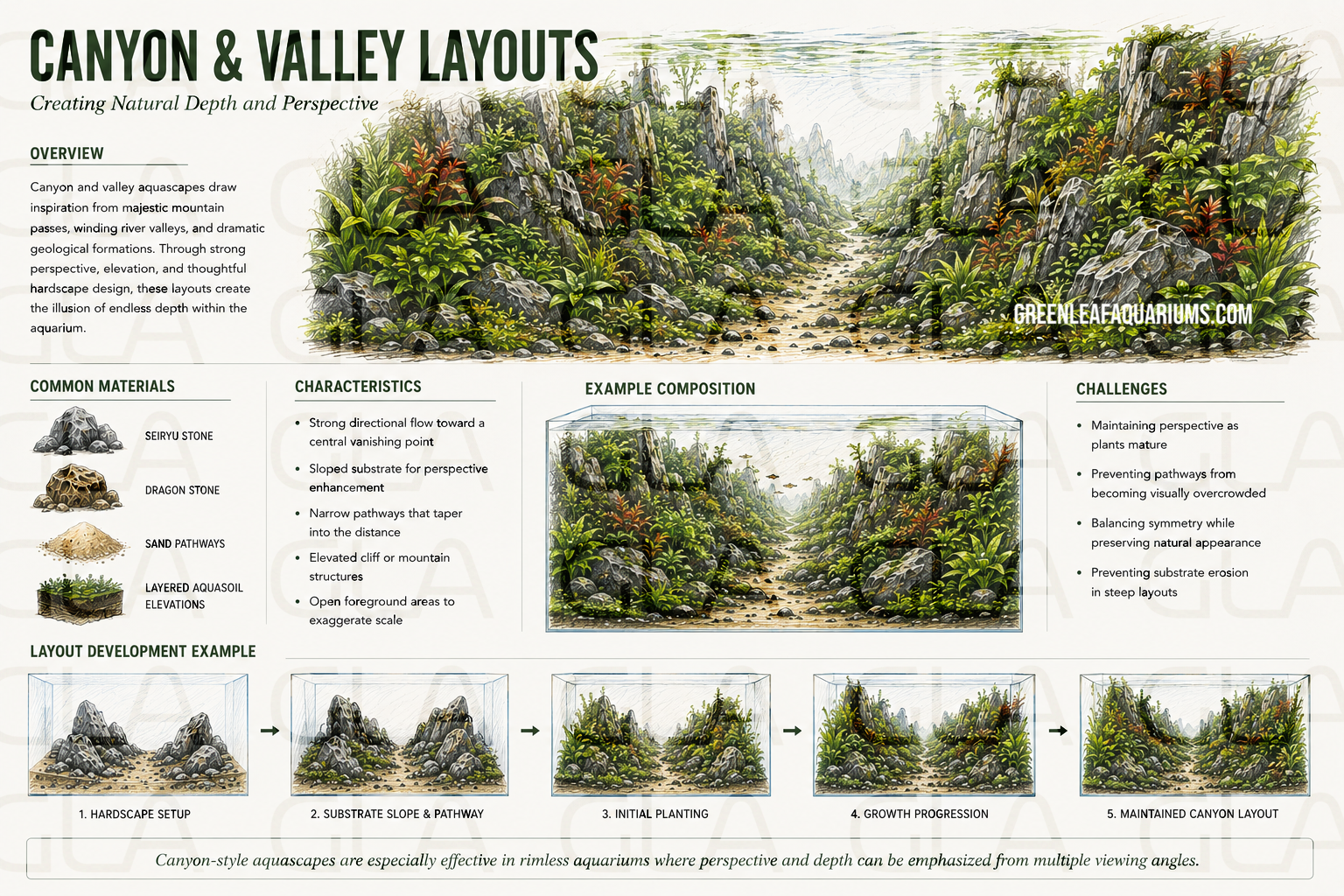
8. Canyon & Valley Layouts
Overview
Canyon and valley aquascapes are inspired by mountain passes, river valleys, and dramatic geological formations. These layouts use perspective, elevation, and converging hardscape lines to create the illusion of expansive depth within the aquarium.
Common Materials
- Seiryu Stone
- Dragon Stone
- Sand pathways
- Layered aquasoil elevations
Characteristics
- Strong directional flow toward a central vanishing point
- Sloped substrate for perspective enhancement
- Narrow pathways that taper into the distance
- Elevated cliff or mountain structures
- Open foreground areas to exaggerate scale
Challenges
- Maintaining perspective as plants mature
- Preventing pathways from becoming visually overcrowded
- Balancing symmetry while preserving natural appearance
- Preventing substrate erosion in steep layouts
Canyon-style aquascapes are especially effective in rimless aquariums where perspective and depth can be emphasized from multiple viewing angles.
Core Hardscape Design Principles
Golden Ratio & Rule of Thirds
Positioning focal points near intersections created by dividing the aquarium into thirds often produces more balanced and visually natural compositions.
Avoid placing major focal points directly in the center of the aquarium unless intentionally designing a symmetrical layout.
Layering for Depth
Depth can be enhanced by combining larger hardscape elements in the foreground with progressively smaller materials toward the background.
Additional depth techniques include:
- Sloping substrate upward toward the back
- Narrowing pathways into the distance
- Using finer textures in background areas
- Reducing plant leaf size toward the rear of the aquarium
Negative Space
Open areas of sand, gravel, or minimally planted substrate help create contrast and visual breathing room.
Negative space prevents layouts from appearing overcrowded while helping emphasize focal points and improve perspective.
Flow & Direction
The orientation of rocks, wood, and plant growth should guide the viewer’s eye naturally through the aquarium.
Directional flow can mimic:
- Water current
- Wind direction
- Erosion patterns
- Natural tree growth
- Mountain slopes and valleys
Consistent directional flow is one of the defining characteristics of natural-looking aquascapes.
Texture & Contrast
Combining contrasting textures creates visual complexity and realism.
Examples include:
- Rough Seiryu stone against smooth sand
- Broadleaf plants beside fine stem plants
- Dense planting contrasted with open substrate
- Dark driftwood paired with bright green carpeting plants
Texture contrast helps create separation between different visual layers within the aquascape.
Hardscape Materials & Their Uses
Rocks
Common Types
- Seiryu Stone
- Dragon Stone
- Ryuoh Stone
- Lava Rock
- River Stone
Uses
- Establish focal points
- Build cliffs and elevation
- Create pathways and structure
- Anchor planting zones
Tips
- Rinse thoroughly before use
- Some rocks may influence water chemistry and pH
- Match stone texture and coloration consistently throughout the layout
- Avoid mixing too many unrelated rock types
Driftwood
Common Types
- Spiderwood
- Manzanita Wood
- River Wood
- Red Moor Wood
- Mopani Wood
- Talawa
- Tiger Wood
Uses
- Mimic roots and branches
- Create directional flow
- Add vertical structure and depth
- Support epiphytes and mosses
Tips
- Pre-soak or boil when possible
- Use aquarium-safe adhesives or thread for attaching plants
- Position wood to appear naturally rooted or weathered
- Angle branches to support overall visual flow
Substrate
Common Types
- Nutrient-rich aquasoils
- Decorative sand
- Fine gravel
- Clay-based planted substrates
Uses
- Root support for aquatic plants
- Elevation and depth creation
- Pathways and visual separation
- Nutrient storage and biological filtration support
Tips
- Slope substrate upward toward the rear for perspective
- Use sand selectively to preserve visual contrast
- Prevent excessive mixing between decorative sand and nutrient soils
Combining Hardscape with Planting Strategies
Foreground
Foreground plants help soften hardscape transitions while enhancing scale and perspective.
Common foreground plants include:
- Dwarf Hairgrass
- Monte Carlo
- Hemianthus callitrichoides
- Staurogyne repens
Small stones and detailed hardscape textures can help create miniature landscape effects.
Midground
Midground plants create transition zones between foreground carpeting plants and taller background species.
Common midground plants include:
- Cryptocoryne wendtii
- Java Fern
- Bucephalandra
- Hygrophila pinnatifida
Midground areas are often where hardscape and planting become most integrated.
Background
Background plants frame the aquascape and help reinforce depth.
Common background plants include:
- Vallisneria
- Rotala species
- Ludwigia species
- Limnophila species
Tall background plants can soften hardscape edges while creating movement and contrast.
Matching Fertilizer Strategies to Aquascape Style
Different planted aquarium styles have very different nutrient demands depending on plant mass, lighting intensity, CO2 stability, growth rate, and maintenance goals.
The GLA Nectar fertilizer system is designed to support a wide range of planted aquarium environments, from slower-growing low-maintenance aquascapes to demanding high-energy planted aquariums.
The lineup includes:
GLA Nectar fertilizers are designed around balanced nutrient ratios intended to support stable nutrient availability, efficient plant uptake, and long-term planted aquarium health.
Low-Maintenance Aquascapes
Lean nutrient supplementation using GLA Nectar AIO, GLA Nectar AIO/S, or lighter dosing with GLA Macros Nectar and GLA Micros Nectar can help support slower-growing plants such as mosses, Anubias, ferns, and Cryptocoryne species.
Moderate Maintenance Aquascapes
Balanced nutrient supplementation using GLA Macros Nectar and GLA Micros Nectar, or balanced dosing with GLA Nectar AIO or GLA Nectar AIO/S, can support mixed planted layouts with moderate growth rates and more diverse plant selection.
High-Tech Aquascapes
Higher-energy nutrient supplementation using GLA Macros Nectar and GLA Micros Nectar, or higher-energy dosing with GLA Nectar AIO or GLA Nectar AIO/S, can support dense carpeting plants, stronger coloration, and aggressive plant growth in aquariums with stable CO2 injection and stronger lighting.
For detailed fertilizer schedules, dosing strategies, and nutrient recommendations, visit the complete GLA Nectar Guide and GLA Nectar Dosing Calculator.
Common Hardscape Design Mistakes
Even experienced aquascapers can encounter compositional issues when designing planted aquariums. Avoiding common hardscape mistakes can significantly improve visual balance, realism, and long-term aquarium stability.
Centering the Main Focal Point
Placing the primary hardscape feature directly in the center of the aquarium can often create a static or artificial appearance. Offset focal points generally produce more natural visual balance.
Overcrowding the Layout
Using too many rocks, wood pieces, or plant species can reduce visual clarity and make the aquarium feel chaotic.
Strategic negative space often improves depth, contrast, and overall realism.
Mixing Too Many Material Types
Combining unrelated rock textures or wood styles can disrupt visual cohesion.
Most successful aquascapes use a limited and consistent material palette.
Poor Substrate Slope
Flat substrate layouts often appear shallow and less dynamic.
Raising substrate elevation toward the rear of the aquarium can dramatically improve depth perception and perspective.
Inconsistent Directional Flow
Rocks, wood, and plant growth should generally support a consistent visual direction.
Conflicting angles can make layouts appear unnatural or visually confusing.
Ignoring Future Plant Growth
Many layouts appear balanced initially but become overcrowded once plants mature.
Planning for future plant mass is critical for preserving long-term structure and open space.
Oversized Hardscape for Aquarium Dimensions
Hardscape that is too large for the aquarium can reduce perspective and limit planting flexibility.
Proper scale is one of the most important aspects of convincing aquascape composition.
Advanced Aquascaping Strategies
Dry Start Method
The dry start method is commonly used for carpeting plants such as:
- Hemianthus callitrichoides
- Monte Carlo
- Glossostigma
Allowing carpeting plants to establish roots before flooding can improve carpet density and reduce initial floating or melt.
Hardscape First, Plants Later
Building the hardscape before planting allows aquascapers to refine composition, perspective, and visual flow without plant growth obscuring structural adjustments.
Many aquascapers temporarily secure hardscape materials before final planting to evaluate layout balance from multiple viewing angles.
Water Flow & Filtration Integration
Water circulation should complement the hardscape layout rather than fight against it.
Proper filter placement can help:
- Prevent debris accumulation
- Improve CO2 distribution
- Enhance nutrient circulation
- Reduce dead zones within dense hardscape structures
Stable CO2 distribution and water movement are often critical factors in successful high-energy planted aquariums.
Maintenance Tips for Long-Term Success
Regular Trimming & Pruning
Consistent pruning helps maintain shape, improve light penetration, and prevent aggressive plants from overwhelming the layout.
Routine Water Changes
Regular water changes help maintain nutrient balance, improve water clarity, and reduce excess organic accumulation.
Algae Management
Algae control is often closely tied to overall aquarium balance.
Helpful strategies include:
- Stable CO2 levels
- Consistent nutrient availability
- Controlled lighting duration
- Proper filtration and circulation
- Introducing algae eaters such as Amano shrimp or Otocinclus
Final Thoughts
Successful nature aquariums combine artistic composition with biological balance. Strong hardscape design, thoughtful planting strategies, stable nutrient availability, and long-term maintenance planning all work together to create immersive underwater landscapes.
Whether designing a minimalist Iwagumi layout, a dramatic Ryoboku forest, or a densely planted Dutch aquarium, understanding the relationship between hardscape, plants, lighting, CO2, and nutrient management is one of the keys to building healthy and visually compelling planted aquariums.
The most successful aquascapes are often built around balance rather than excess. Matching aquarium goals, maintenance expectations, lighting intensity, CO2 stability, and nutrient availability to the needs of the aquarium typically produces healthier and more stable long-term results.
Recent Posts
-
Nature Aquarium Dry Fertilizer Dosing Guide, Dosing Charts & Calculator, & DIY Nutrient Strategies – PPS-Pro & Estimative Index (EI) Methods
Nature Aquarium Dry Fertilizer Dosing Guide, Dosing Charts & Calculator, & DIY Nutrient Strategies
-
GLA Nectar Liquid Fertilizers – A Comprehensive Guide and Dosing Strategies
Achieving a thriving, beautifully planted aquarium requires more than just adding water and light; i
-
Aquarium CO2 Installation & Monitoring Guide
Aquarium CO2 Installation & Monitoring Guide A well-designed aquarium CO2 system is one of the most