
Nature Aquarium Aquascape & Hardscape Inspiration, Layout Ideas & Aquascaping Concepts
Nature Aquarium Aquascape & Hardscape Inspiration, Layout Ideas & Aquascaping Concepts
Creating a successful planted aquarium involves balancing aesthetics, plant selection, lighting intensity, nutrient availability, CO2 stability, and long-term maintenance goals. Some aquascapes are designed for simplicity and slower growth, while others are highly dynamic systems requiring strong lighting, injected CO2, and regular trimming.
Below are several aquascaping concepts ranging from low-maintenance layouts to advanced high-tech planted aquariums. These examples can serve as inspiration while helping you better understand how aquarium design, plant selection, and maintenance style work together.
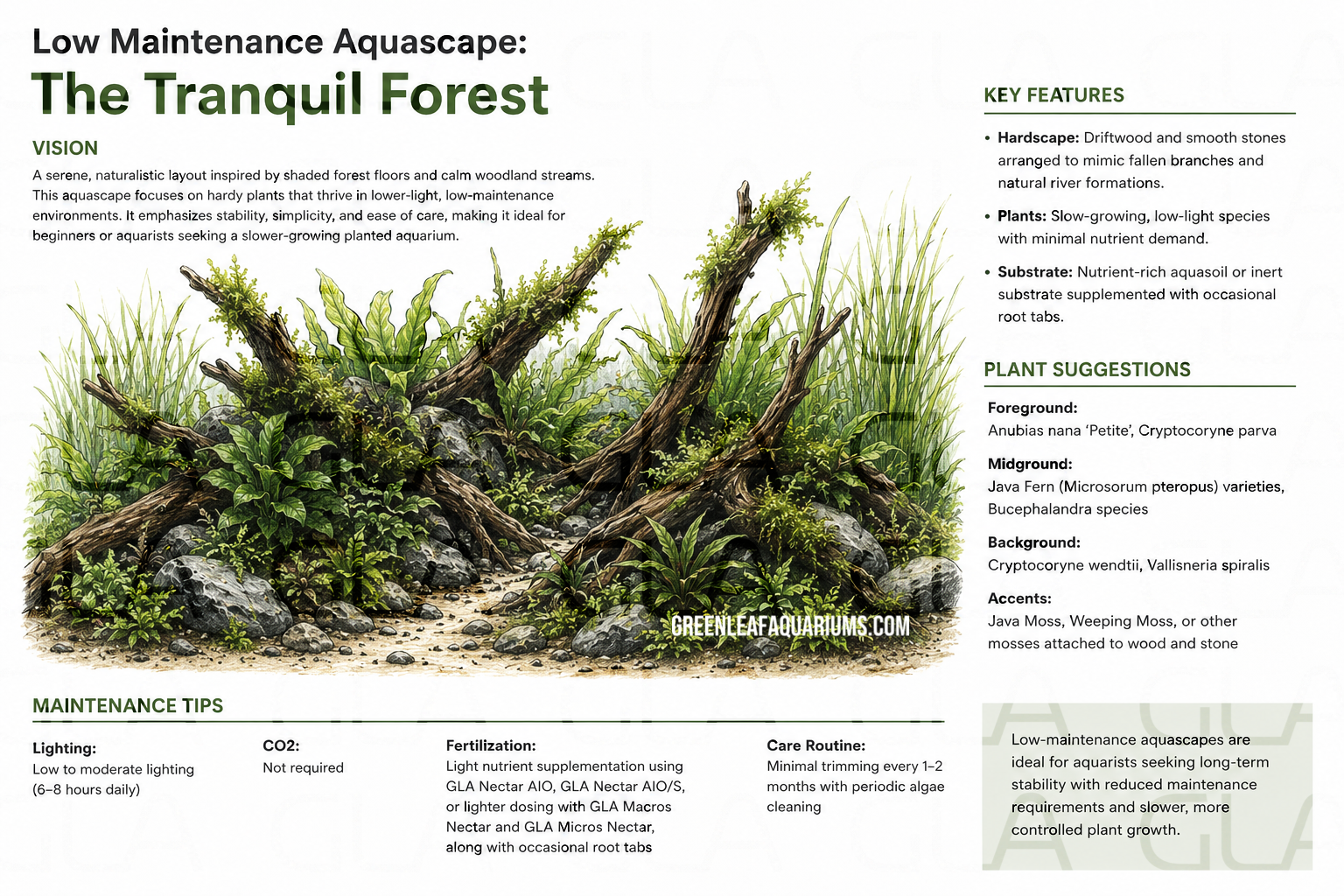
1. Low Maintenance Aquascape: "The Tranquil Forest"
Vision
A serene, naturalistic layout inspired by shaded forest floors and calm woodland streams. This aquascape focuses on hardy plants that thrive in lower-light, low-maintenance environments. It emphasizes stability, simplicity, and ease of care, making it ideal for beginners or aquarists seeking a slower-growing planted aquarium.
Key Features
- Hardscape: Driftwood and smooth stones arranged to mimic fallen branches and natural river formations.
- Plants: Slow-growing, low-light species with minimal nutrient demand.
- Substrate: Nutrient-rich aquasoil or inert substrate supplemented with occasional root tabs.
Plant Suggestions
- Foreground: Anubias nana 'Petite', Cryptocoryne parva
- Midground: Java Fern (Microsorum pteropus) varieties, Bucephalandra species
- Background: Cryptocoryne wendtii, Vallisneria spiralis
- Accents: Java Moss, Weeping Moss, or other mosses attached to wood and stone
Maintenance Tips
- Lighting: Low to moderate lighting (6–8 hours daily)
- CO2: Not required
- Fertilization: Light nutrient supplementation using GLA Nectar AIO, GLA Nectar AIO/S, or lighter dosing with GLA Macros Nectar and GLA Micros Nectar, along with occasional root tabs
- Care Routine: Minimal trimming every 1–2 months with periodic algae cleaning
Low-maintenance aquascapes are ideal for aquarists seeking long-term stability with reduced maintenance requirements and slower, more controlled plant growth.
2. Moderate Maintenance Aquascape: "The Riverbank Scene"
Vision
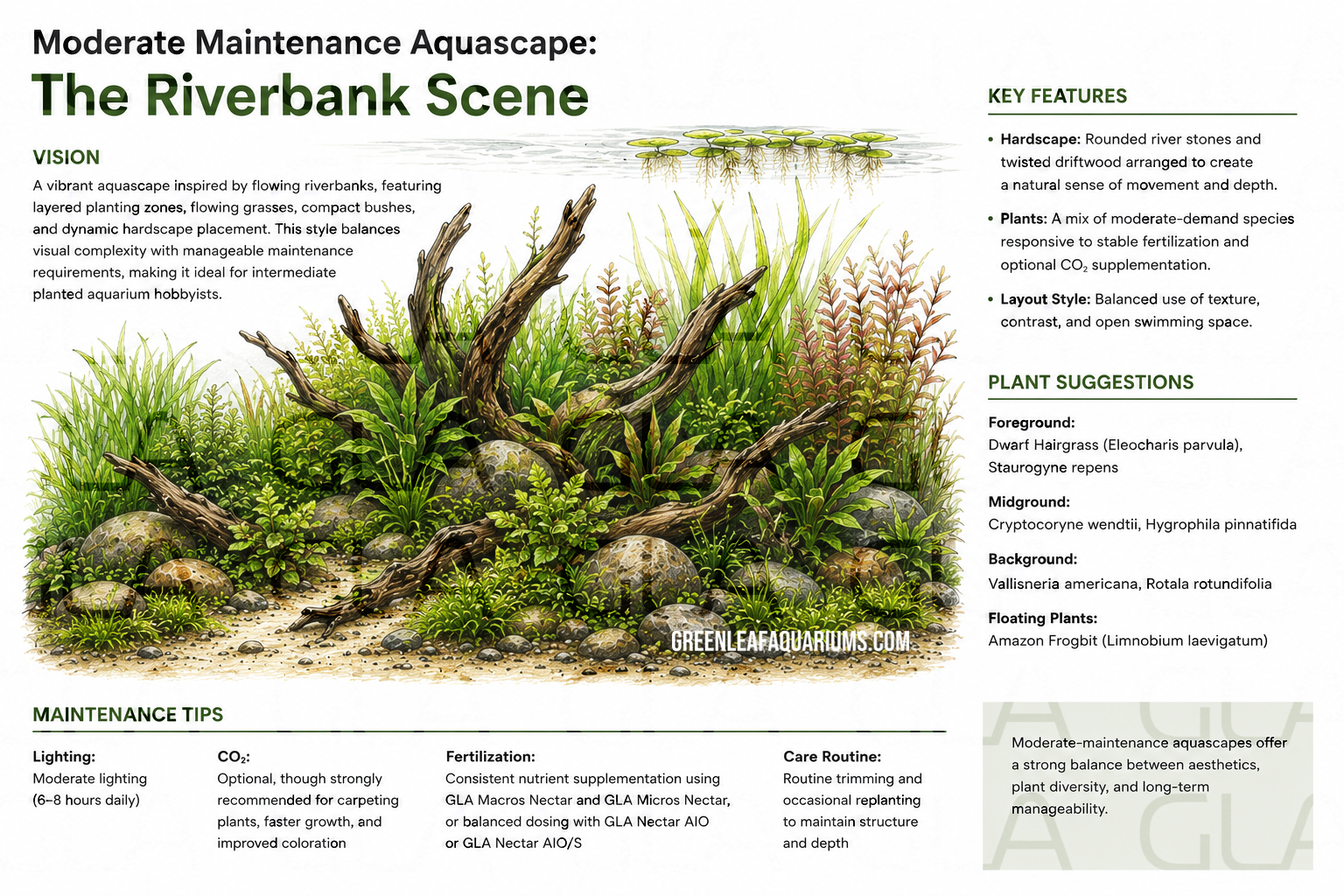
A vibrant aquascape inspired by flowing riverbanks, featuring layered planting zones, flowing grasses, compact bushes, and dynamic hardscape placement. This style balances visual complexity with manageable maintenance requirements, making it ideal for intermediate planted aquarium hobbyists.
Key Features
- Hardscape: Rounded river stones and twisted driftwood arranged to create a natural sense of movement and depth.
- Plants: A mix of moderate-demand species responsive to stable fertilization and optional CO2 supplementation.
- Layout Style: Balanced use of texture, contrast, and open swimming space.
Plant Suggestions
- Foreground: Dwarf Hairgrass (Eleocharis parvula), Staurogyne repens
- Midground: Cryptocoryne wendtii, Hygrophila pinnatifida
- Background: Vallisneria americana, Rotala rotundifolia
- Floating Plants: Amazon Frogbit (Limnobium laevigatum)
Maintenance Tips
- Lighting: Moderate lighting (6–8 hours daily)
- CO2: Optional, though strongly recommended for carpeting plants, faster growth, and improved coloration
- Fertilization: Consistent nutrient supplementation using GLA Macros Nectar and GLA Micros Nectar, or balanced dosing with GLA Nectar AIO or GLA Nectar AIO/S
- Care Routine: Routine trimming and occasional replanting to maintain structure and depth
Moderate-maintenance aquascapes offer a strong balance between aesthetics, plant diversity, and long-term manageability.
3. Higher Maintenance Aquascape: "The Vibrant Cliffside"
Vision
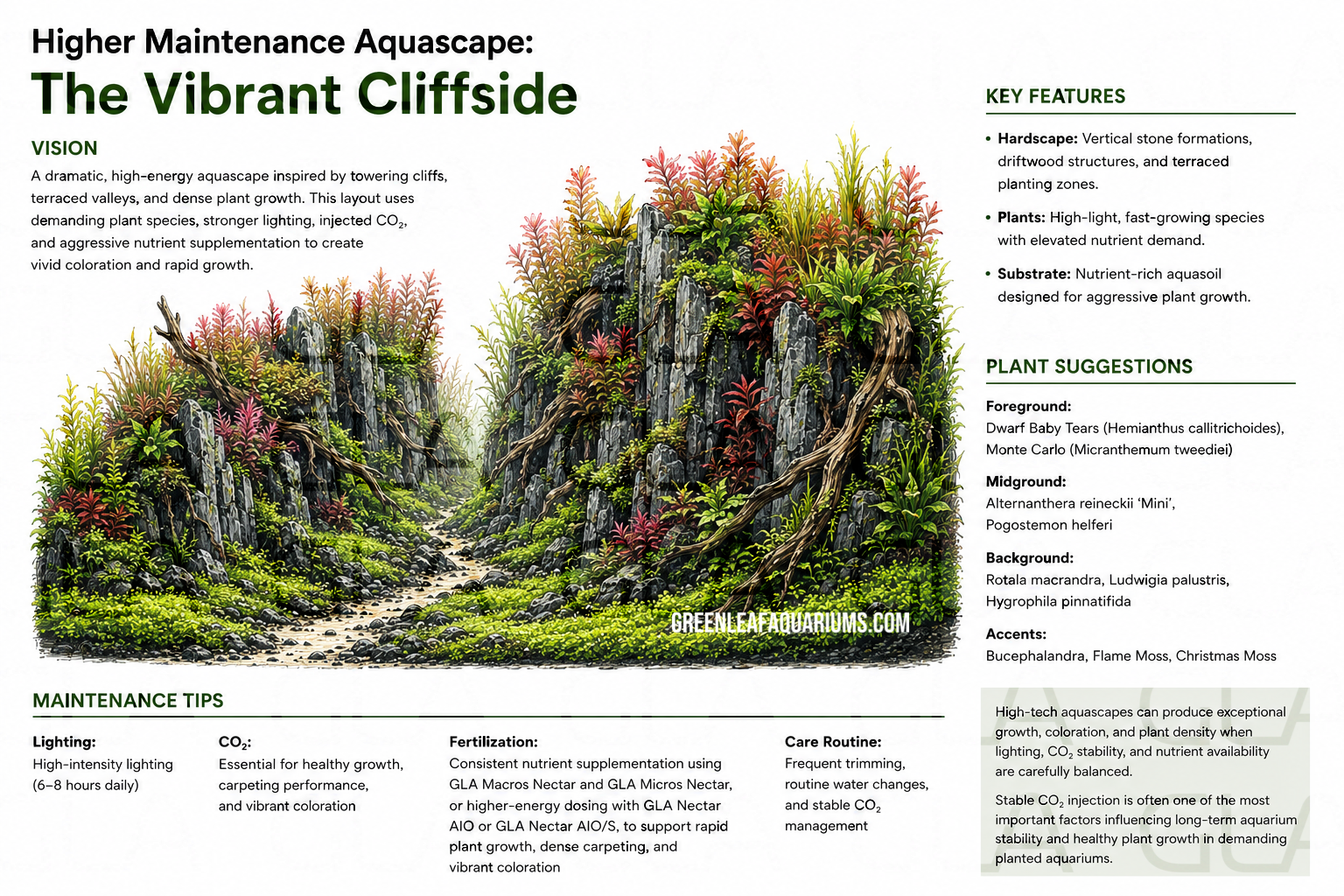
A dramatic, high-energy aquascape inspired by towering cliffs, terraced valleys, and dense plant growth. This layout uses demanding plant species, stronger lighting, injected CO2, and aggressive nutrient supplementation to create vivid coloration and rapid growth.
Key Features
- Hardscape: Vertical stone formations, driftwood structures, and terraced planting zones.
- Plants: High-light, fast-growing species with elevated nutrient demand.
- Substrate: Nutrient-rich aquasoil designed for aggressive plant growth.
Plant Suggestions
- Foreground: Dwarf Baby Tears (Hemianthus callitrichoides), Monte Carlo (Micranthemum tweediei)
- Midground: Alternanthera reineckii 'Mini', Pogostemon helferi
- Background: Rotala macrandra, Ludwigia palustris, Hygrophila pinnatifida
- Accents: Bucephalandra, Flame Moss, Christmas Moss
Maintenance Tips
- Lighting: High-intensity lighting (6–8 hours daily)
- CO2: Essential for healthy growth, carpeting performance, and vibrant coloration
- Fertilization: Consistent nutrient supplementation using GLA Macros Nectar and GLA Micros Nectar, or higher-energy dosing with GLA Nectar AIO or GLA Nectar AIO/S, to support rapid plant growth, dense carpeting, and vibrant coloration
- Care Routine: Frequent trimming, routine water changes, and stable CO2 management
High-tech aquascapes can produce exceptional growth, coloration, and plant density when lighting, CO2 stability, and nutrient availability are carefully balanced. Stable CO2 injection is often one of the most important factors influencing long-term aquarium stability and healthy plant growth in demanding planted aquariums.
Aquascape Maintenance Comparison Chart
| Maintenance Level | Key Features | Plant Focus | Lighting | CO2 | Fertilization |
|---|---|---|---|---|---|
| Low Maintenance | Slower growth, shaded layouts, hardy plants | Crypts, Anubias, Java Fern, mosses | Low to moderate | Not required | Light nutrient supplementation |
| Moderate Maintenance | Balanced growth with layered planting | Dwarf Hairgrass, Crypts, Hygrophila | Moderate | Optional, recommended | Consistent nutrient supplementation |
| Higher Maintenance | Dense planting, vibrant coloration, rapid growth | Rotala, Alternanthera, carpeting plants | High intensity | Essential | Higher-energy nutrient supplementation |
Matching Fertilizer Dosing to Your Aquascape
Different planted aquariums have very different nutrient demands depending on lighting intensity, CO2 usage, plant density, growth rate, substrate composition, filtration, and overall maintenance goals.
Lower-maintenance aquariums with slower-growing plants generally require lighter nutrient dosing, while high-energy aquascapes with injected CO2, strong lighting, and dense plant growth often benefit from more aggressive nutrient supplementation and more frequent maintenance.
The GLA Nectar fertilizer system is designed to scale nutrient availability across a wide range of planted aquarium styles — from low-tech beginner aquariums to advanced high-tech nature aquascapes. The lineup includes simplified all-in-one solutions such as GLA Nectar AIO and GLA Nectar AIO/S, as well as separate macro and micronutrient systems using GLA Macros Nectar and GLA Micros Nectar for aquarists who prefer separate nutrient control and flexible alternating dosing schedules. GLA Nectar AIO and AIO/S can also be successfully used in many high-tech planted aquariums when dosed appropriately for plant mass, lighting intensity, and CO2 demand.
GLA Nectar fertilizers are designed around balanced nutrient ratios intended to support stable nutrient availability, efficient plant uptake, and long-term planted aquarium health.
Low Maintenance Aquascapes
Low-maintenance planted aquariums featuring plants such as Anubias, Java Fern, Bucephalandra, Cryptocoryne, and mosses generally have lower nutrient demand and slower growth rates.
These aquariums are often well-suited for aquarists seeking slower, controlled growth with reduced maintenance requirements.
Moderate Maintenance Aquascapes
Balanced planted aquariums with mixed stem plants, carpeting species, and moderate lighting typically require more consistent nutrient availability to support healthy growth and coloration.
Separating Macros and Micros into alternating schedules can help maintain stable nutrient availability while providing greater flexibility and control.
Higher Maintenance Aquascapes
High-tech planted aquariums with injected CO2, strong lighting, dense carpeting plants, and fast-growing stem species typically require significantly higher nutrient availability and more active maintenance routines.
Higher-energy aquascapes often produce faster growth, stronger coloration, and denser plant mass when nutrient availability, lighting, and CO2 stability are properly balanced.
Every Aquarium Is Unique
Every planted aquarium is biologically unique. Plant mass, livestock load, substrate composition, filtration, lighting intensity, and CO2 stability can all influence nutrient demand and fertilizer consumption.
Fertilizer recommendations should be used as a starting framework and adjusted gradually based on plant response, aquarium stability, and overall growth goals.
Observation remains one of the most important aspects of successful planted aquarium maintenance. Healthy plants typically display stable growth, vibrant coloration, and minimal algae pressure.
Successful planted aquariums are typically built around balance rather than excess. Matching lighting, CO2 availability, nutrient levels, plant mass, and maintenance expectations to the goals of the aquarium often produces healthier and more stable long-term results than aggressively maximizing any single variable.
GLA Nectar Dosing Guide & Calculator
For detailed fertilizer schedules, nutrient targets, dosing frequencies, PPS-Pro and EI-style approaches, and aquarium-specific recommendations, visit the complete GLA Nectar Guide and GLA Nectar Dosing Calculator.
The calculator includes:
- Lean, Balanced, and High-Tech dosing recommendations
- Daily and alternating dosing schedules
- Macros and Micros nutrient separation schedules
- Aquarium-specific dosing calculations
- PPS-Pro and EI-inspired nutrient approaches
By matching nutrient availability to your aquarium's lighting intensity, CO2 usage, and plant demand, it becomes much easier to maintain stable, healthy, and visually impressive planted aquariums over the long term.
Recent Posts
-
Nature Aquarium Dry Fertilizer Dosing Guide, Dosing Charts & Calculator, & DIY Nutrient Strategies – PPS-Pro & Estimative Index (EI) Methods
Nature Aquarium Dry Fertilizer Dosing Guide, Dosing Charts & Calculator, & DIY Nutrient Strategies
-
GLA Nectar Liquid Fertilizers – A Comprehensive Guide and Dosing Strategies
Achieving a thriving, beautifully planted aquarium requires more than just adding water and light; i
-
Aquarium CO2 Installation & Monitoring Guide
Aquarium CO2 Installation & Monitoring Guide A well-designed aquarium CO2 system is one of the most