
Learn: The CO2 Regulator and Aquarium CO2 System
Understanding the Planted Aquarium CO2 System
Carbon dioxide (CO2) is one of the most important components in a healthy planted aquarium. During photosynthesis, aquatic plants use CO2 along with light and nutrients to produce energy required for growth, coloration, and long-term health.
In the planted aquarium, CO2 is introduced through the use of a pressurized CO2 system consisting of a CO2 regulator, cylinder, tubing, diffuser, and related components. A properly configured aquarium CO2 system provides stable, efficient carbon delivery that supports healthier plant growth and improved aquarium stability.
Setting up a planted aquarium CO2 system for the first time can seem intimidating, but understanding the role of each component makes the process much easier. This guide explains the major parts of a planted aquarium CO2 system and how they work together.
The CO2 Cylinder
The CO2 cylinder stores carbon dioxide under high pressure. Inside the cylinder, CO2 exists primarily in liquid form, with gaseous CO2 occupying the remaining headspace.
Because liquid CO2 is present, the cylinder maintains a relatively stable internal pressure until most of the liquid has been depleted. For this reason, a full CO2 cylinder will typically read approximately 800–1000 PSI depending on temperature.
- CO2 cylinders should always be used in the upright position
- Cylinders must be properly secured during use
- Cylinders included with GLA CO2 systems ship empty and must be filled locally
The CO2 Pressure Regulator
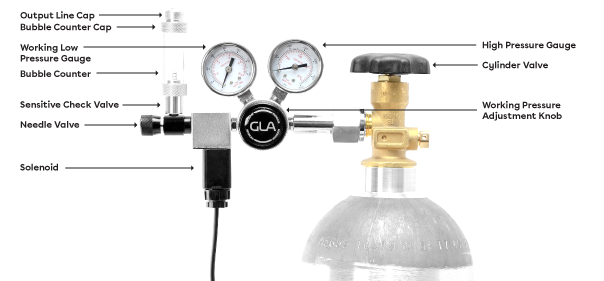
The CO2 regulator is the central control component of the planted aquarium CO2 system. Its purpose is to reduce the high pressure inside the CO2 cylinder to a lower, usable working pressure suitable for aquarium CO2 injection.
Modern planted aquarium CO2 regulators include pressure reduction stages, working pressure adjustment, precision needle valve control, solenoid valve automation, bubble counter monitoring, and safety pressure relief systems.
GLA CO2 regulators are engineered using premium pneumatic components and undergo inspection and testing prior to shipment.
Single Stage vs Dual Stage Regulators
Single-stage regulators reduce cylinder pressure in one step and are commonly used for standard planted aquarium setups.
Dual-stage regulators reduce pressure in two stages, providing significantly greater pressure stability as the CO2 cylinder empties. Dual-stage regulators are specifically designed to minimize pressure fluctuations and help prevent end-of-tank dump.
For aquarists seeking maximum stability and long-term consistency, dual-stage regulators such as the GLA DS-Mini and PRO-DS systems offer substantial performance advantages.
High Pressure Gauge
The high pressure gauge displays the pressure present inside the CO2 cylinder. As long as liquid CO2 remains inside the cylinder, the gauge will typically read approximately 800–1000 PSI. Once the liquid CO2 becomes depleted, cylinder pressure will begin dropping rapidly, indicating the cylinder should be refilled.
Working Pressure Gauge
The working pressure gauge displays the regulator’s output pressure. This lower pressure is the usable pressure being delivered from the regulator toward the aquarium.
- GRO Series: 0–70 PSI
- DS-Mini: 0–60 PSI
- PRO-DS: 0–140 PSI
Working Pressure Adjustment
The working pressure adjustment mechanism allows the user to increase or decrease output pressure. Depending on the regulator model, this may be accomplished using an adjustment knob, adjustment screw, or T-handle.
Increasing working pressure can improve diffuser performance in some applications, particularly when using inline diffusers or larger ceramic diffusers.
Tank Connection & CO2 Seal
The regulator attaches directly to the CO2 cylinder valve using the appropriate installation fitting.
- CGA-320: USA and Canada
- DIN477: many international regions including Europe, UK, and Australia
A proper CO2 tank seal is critical to ensuring a leak-free connection between the regulator and cylinder. GLA regulators include a GLA OEM CO2 tank seal designed for secure installation.
- Always use proper installation technique
- Avoid overtightening
- Use appropriate tools only when necessary
- Improper installation is one of the most common causes of CO2 leaks
Solenoid Valve
The solenoid valve is an electromechanical ON/OFF valve that controls the flow of CO2 from the regulator to the aquarium.
The solenoid is typically connected to a timer, smart outlet, or pH controller. This allows CO2 injection to be automated alongside the aquarium lighting schedule.
Most planted aquarium hobbyists run CO2 only during the aquarium photoperiod.
Precision Needle Valve
The precision needle valve allows fine adjustment of CO2 flow into the aquarium. This component is responsible for controlling the bubble rate and fine-tuning CO2 delivery.
A high-quality precision needle valve provides stable bubble rate control, precise adjustment capability, improved consistency over time, and reduced drift or fluctuation.
In planted aquariums, stable CO2 delivery is one of the most important factors in achieving healthy plant growth and long-term aquarium stability.
Bubble Counter
A bubble counter provides a visual reference for measuring CO2 flow rate. By counting the number of bubbles entering the aquarium per second, aquarists can make fine adjustments to CO2 delivery.
Bubble counters may be integrated into the regulator or installed inline within the tubing. An inline bubble counter placed outside the aquarium stand can make monitoring easier during adjustment.
The Drop Checker
A drop checker is one of the most useful tools for monitoring planted aquarium CO2 levels.
The drop checker contains an indicator solution that changes color based on the concentration of dissolved CO2 in the aquarium. This allows aquarists to visually monitor CO2 levels at a glance.
In modern planted aquarium practice, drop checkers remain one of the most common and practical methods of monitoring CO2 injection. When using a pressurized CO2 system, a drop checker is strongly recommended.
Timer vs pH Controller
Automatic Timer
A timer or smart outlet provides a simple and reliable way to automate aquarium CO2. The regulator solenoid and aquarium lights can be programmed to turn on and off automatically according to the aquarium lighting schedule.
This remains one of the most common methods of operating planted aquarium CO2 systems.
pH Controller
A pH controller continuously monitors aquarium pH and can automate CO2 injection based on a target pH value.
While pH controllers can be useful in some advanced applications, most planted aquarium hobbyists today rely primarily on stable CO2 setup, consistent bubble rate, drop checker monitoring, and observation of fish and plant health.
Regardless of method used, CO2 levels should always be adjusted carefully and monitored responsibly.
Check Valve
A check valve prevents aquarium water from back-siphoning into the regulator or other CO2 equipment. The check valve installs inline within the CO2 tubing and allows flow in one direction only.
This is a simple but extremely important safety component in any planted aquarium CO2 system.
CO2 Resistant Tubing
CO2-resistant tubing safely transports CO2 from the regulator to the aquarium.
Using proper CO2-resistant tubing is important because standard silicone airline tubing allows CO2 gas to slowly permeate through the tubing walls, reducing efficiency.
- Reduces gas loss
- Improves efficiency
- Maintains stable CO2 delivery
- Increases long-term reliability
The CO2 Diffuser
The CO2 diffuser is responsible for dispersing CO2 into the aquarium water. As CO2 passes through the diffuser’s ceramic membrane, it is broken into extremely fine bubbles that dissolve more efficiently into the aquarium.
Efficient diffusion improves CO2 saturation, plant uptake, and overall system efficiency.
- In-tank diffusers
- Inline diffusers
- External reactors
Selecting the appropriate diffuser size and style is important for achieving proper CO2 distribution throughout the aquarium.
Larger aquariums may benefit from larger diffusers, multiple diffusers, external reactors, or improved circulation and flow placement.
Final Thoughts
A properly configured CO2 system can dramatically improve planted aquarium growth, health, and overall aquascape performance.
Whether using a simple beginner setup or an advanced dual-stage modular system, stability and consistency are key to successful planted aquarium CO2 injection.
GLA CO2 systems are engineered to provide reliable, professional-grade CO2 performance for aquarists ranging from beginners to advanced hobbyists and professional aquascapers.
With proper setup, monitoring, and adjustment, a planted aquarium CO2 system can provide years of stable and rewarding performance.
Recent Posts
-
GLA Nectar Liquid Fertilizers – A Comprehensive Guide and Dosing Strategies
Achieving a thriving, beautifully planted aquarium requires more than just adding water and light; i
-
Nature Aquarium Dry Fertilizer Dosing Guide, Dosing Charts & Calculator, & DIY Nutrient Strategies – PPS-Pro & Estimative Index (EI) Methods
Nature Aquarium Dry Fertilizer Dosing Guide, Dosing Charts & Calculator, & DIY Nutrient Strategies
-
How to: GLA Aquarium CO2 Regulator, CO2 System, CO2 Tank Refills, Install & Monitor CO2 Drop Checker
How to Install: GLA GRO Aquarium CO2 Regulator How to Install: GLA PRO-DS (Modular) Aquarium CO2 Re